


CPR for infants is a lifesaving skill every parent, grandparent, and caregiver must understand—because in an emergency, every second counts.
Key Takeaways
- Acting within 1-5 minutes with CPR on infants dramatically increases survival odds—delays beyond this window sharply reduce chances of recovery.
- Common mistakes include hesitating or waiting for help, using incorrect technique, or mistaking the rules for adult CPR for babies.
- Practice and clear knowledge of infant CPR steps can save lives, especially since infants’ cardiac arrest survival rates remain critically low in real-world settings.
- What Is Infant CPR and Why Is It So Critical?
- Step-by-Step CPR for Infants: What To Do When Every Second Counts
- Real-World Pitfalls, Challenges, and What Truly Works
- Conclusion
- Frequently Asked Questions
What Is Infant CPR and Why Is It So Critical?
Infant CPR (cardiopulmonary resuscitation) refers to urgent chest compressions and rescue breaths for babies under one year old who have stopped breathing or lost their pulse. Unlike adults, infants are more likely to suffer cardiac arrest due to breathing issues, suffocation, or sudden illness. The survival window is brutally short—research shows starting CPR in under five minutes nearly doubles a baby’s chance of survival compared to delayed action.

Yet the outlook is sobering: current studies show that out-of-hospital cardiac arrest (OHCA) survival rates for infants are only about 6.5% to hospital discharge (source). In-hospital survival is slightly better, but the reality is that most infants don’t make it without immediate, high-quality intervention (source). This critical timing is also highlighted in numerous parent emergency stories, where hesitation or waiting significantly worsened outcomes.
If you’re thinking about overall home safety, check out baby first aid kit essentials to be prepared for all emergencies, not just CPR.
Step-by-Step CPR for Infants: What To Do When Every Second Counts
Stay calm, work fast, and follow these evidence-backed infant CPR steps the moment you notice a baby is unresponsive and not breathing normally:
- Check for responsiveness: Tap the baby’s foot or gently shout their name. If there is no reaction, proceed.
- Shout for help. If someone is nearby, have them call 911 and get an AED while you begin CPR.
- Open airway: Place the baby on their back. Tilt the head back slightly with a gentle chin lift (not too far—just enough to open the airway).
- Check for breathing and pulse: Place your ear near the mouth/nose and look for chest movement for up to 10 seconds. Simultaneously, check the brachial pulse (inside the upper arm).
- No breathing or pulse: Start CPR:
- Place two fingers in the center of the chest, just below the nipple line.
- Push down about 1.5 inches (4 cm). Compressions should be fast (at least 100–120 per minute) and allow the chest to fully recoil.
- After 30 compressions, give 2 gentle breaths (cover baby’s nose and mouth with your mouth; breaths should be just enough to see the chest rise).
- If two rescuers are present, use both thumbs side-by-side on the chest and encircle the torso with hands, performing 15 compressions and 2 breaths.
- Continue CPR: Do cycles of compressions and breaths until help arrives or baby begins breathing.
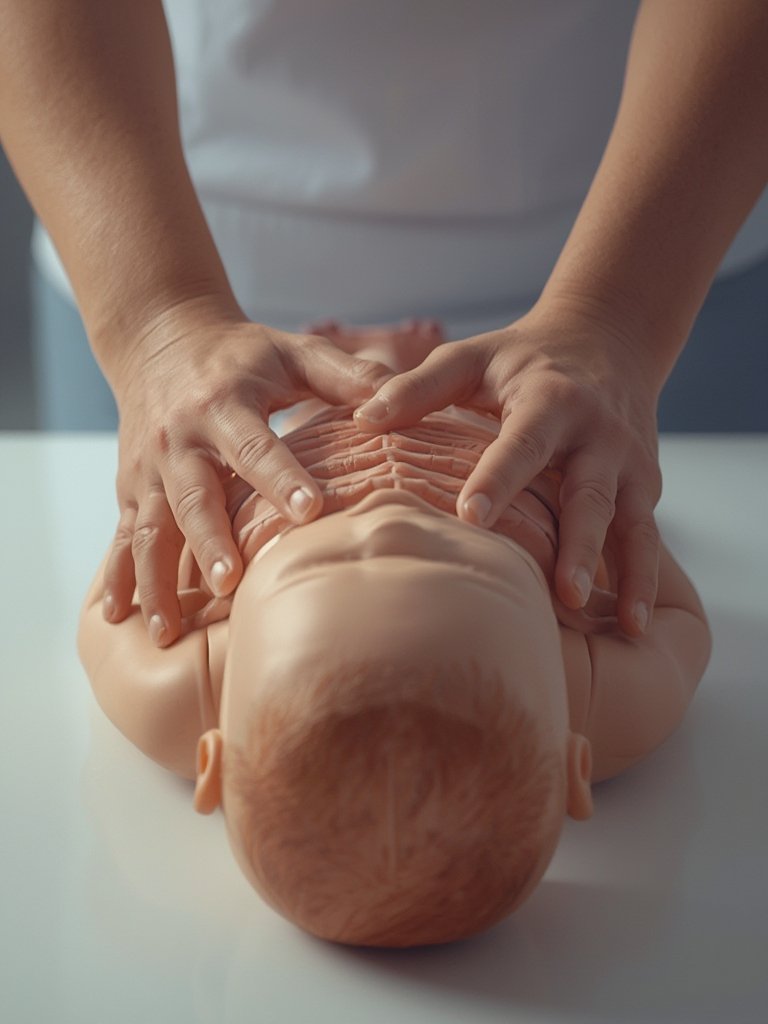
Critical Details for Infants (Do Not Confuse With Adult CPR!):
- Never use the heel of your hand—only two fingers (or thumbs with two rescuers).
- Compression depth is less (1.5 inches vs. 2 inches in adults).
- Do not overextend the neck; airway is easily blocked in infants.
- Use softer breaths than you would for a child or adult.
For more general baby safety tips, see our guide on choking hazards for babies to minimize risks at home.
If the situation involves possible sleep hazards, review our resource on safe sleep for toddlers and infants for crucial prevention advice.
Real-World Pitfalls, Challenges, and What Truly Works
Despite many parents knowing the basics in theory, real-life emergencies often expose gaps. Key research finds:
- Delays in starting CPR: Median time for layperson CPR in real emergencies is 3 minutes, but survival advantage drops sharply if delayed past 5 minutes (source).
- Incorrect technique: Using too much force or the wrong hand placement can break ribs or cause injury. Even brief uncertainty about steps can result in dangerous hesitations.
- Panic and fear of “making it worse”: Many caregivers freeze or do not start at all, worried they’ll harm the infant. Evidence is clear—not doing anything is far more risky.
- Confusing infant and adult/child guidelines: Studies note that most online guides do not clearly stress how infant CPR compressions, breaths, and pressure must be adapted from adult technique (source).
| CPR Parameter | Infants (Under 1 Year) | Children (1-8 Years) | Adults |
|---|---|---|---|
| Compression Method | 2 fingers (one rescuer) 2 thumbs (two rescuers) | 1 or 2 hands | 2 hands |
| Compression Depth | 1.5 inches (4 cm) | 2 inches (5 cm) | 2–2.4 inches (5–6 cm) |
| Rescue Breaths | Mouth covers mouth & nose | Mouth to mouth | Mouth to mouth |
| Ratio (Compress:Breath) | 30:2 (1 rescuer) 15:2 (2 rescuers) | 30:2 (1 rescuer) 15:2 (2 rescuers) | 30:2 |
| Time Criticality |
Greatest survival boost if started in <5 min. Odds drop after 5 min. | Survival window wider (up to 10 min). | Survival advantage can extend up to 10 min. |
For more in-depth advice on baby health signals, see baby fever: what temperature is dangerous? for immediate steps if you suspect illness-related loss of consciousness.

One major knowledge gap? Most well-ranked guides fail to emphasize the severe drop in survival rates when CPR starts after five minutes for infants, while adult-focused advice suggests a longer window. Additionally, many ignore differences in pressure and the reality that infant cardiac arrest is usually due to airway, not heart, problems (source).
Want to proactively build your knowledge? Explore our parenting tips on baby developmental milestones and when babies start crawling to stay ahead on overall safety.
Conclusion
Mastering CPR for infants can mean the difference between life and death. The technique is different, the timing is far more urgent, and your action (not hesitation) determines the outcome. Study, practice, and make sure everyone in your circle knows these steps—the CPR for infants protocol is one you hope never to use, but must always be ready for. Take a certified CPR class, bookmark this page, and review the steps with family. For all-around preparedness, see our content on baby first aid kits and how to baby proof your home.
Be ready. Seconds save infants’ lives.
Frequently Asked Questions
Is infant CPR different from child or adult CPR?
Yes. Infant CPR uses two fingers or two thumbs for compressions, covers both nose and mouth for breaths, and pushes only 1.5 inches deep—never use adult force or hand position.
What if I’m alone and need to perform CPR for infants?
If you’re alone, start CPR immediately and give 2 minutes (5 cycles) before leaving to call emergency services. Always return and continue CPR until help arrives.
Can performing CPR cause harm to the infant?
While CPR can result in injuries like broken ribs, not starting CPR when needed almost guarantees a worse outcome. It is safer to attempt CPR than do nothing.
Are there any ways for parents to practice CPR at home affordably?
Practice on a rolled towel or purchase low-cost infant CPR manikins online. Look for free video guides from respected organizations, but in-person training with feedback offers the best preparation.
When should I stop CPR on an infant?
Stop only when the baby begins to breathe normally, another trained person or EMS takes over, or you are physically unable to continue.